
 By
·
5 minute read
By
·
5 minute read
Key Takeaway
Medical marketing can be a strong niche for agencies because healthcare clients have real budgets, consistent demand, and clear problems to solve. But it is also a trust-driven market where workflows and risk matter as much as leads. Agencies win by specializing, learning how practices operate, and building systems that improve patient experience and staff workload, not just traffic.
Table of Contents
- Do You Need a Niche as a Marketing Agency?
- What Is Medical Marketing?
- Is Medical Marketing Worth the Focus?
- Pros of Medical Marketing
- Cons of Medical Marketing
- What It Takes to Win Trust in Healthcare
- Next Steps
Digital marketing is a huge industry. When you look at the landscape, it feels like the biggest agencies dominate everything. They have more resources, more case studies, and more reach. For smaller teams, it can be hard to see where you fit.
The good news is you don’t have to outspend them. You just have to get more specific. “Digital marketing” is way too broad, but “digital marketing for orthodontists in Austin” is a real lane you can win. In this blog, we’ll break down why choosing a niche can help agencies grow faster, and why medical marketing can be a strong place to start.
Do You Need a Niche as a Marketing Agency?
In theory, an established marketing agency can work in almost any industry. If your team has the resources to spread expertise across multiple markets, that flexibility can be an advantage. For smaller teams, trying to do everything at once often means spreading yourself too thin. That’s especially true when there is real growth to be found by focusing on a specific niche.
It is no different than the SEO advice you would give a client. Ranking for a broad keyword is difficult and slow. Focusing on long-tail keywords helps you rank faster and attracts a more specific audience that can be easier to convert.
The same idea applies to agencies. It helps even more when you can position yourself as an expert, not just in marketing, but in how your work fits into your clients’ actual workflows. Understanding the industry itself gives you an edge over larger agencies that may struggle to earn trust or deliver highly personalized service.
What Is Medical Marketing?
Medical marketing is still a fairly high-level category. It covers marketing services for healthcare providers, practices, and organizations. For newer or smaller teams, trying to serve every type of healthcare client can be overwhelming. Most agencies see better results by starting with one or two specialties, often within a specific region, and expanding from there.
Some of the most common medical marketing niches include:
- Dental marketing
- Orthodontic marketing
- Primary care and family medicine marketing
- Physical therapy and rehabilitation marketing
- Mental health and therapy practice marketing
- Home health and hospice marketing
- Med spa and elective care marketing
This approach lets agencies develop repeatable strategies, stronger case studies, and a deeper understanding of how marketing connects to real clinical workflows.
Is Medical Marketing Worth the Focus?
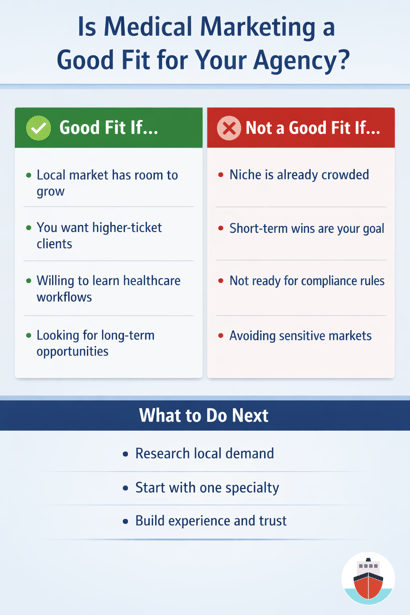
Whether medical marketing is worth it depends on the market you are going after. If you're in a larger city with plenty of practices, or in a smaller region that's not already dominated by a strong agency, it can be a very lucrative focus.
If there are not enough potential clients in your area or the niche is already saturated, you are going to feel that ceiling pretty quickly. Before committing, it is worth doing a bit of market research. Look at how many practices fit your ideal client profile, who is already serving them, and which clinics seem actively invested in growth. The goal is to find a niche with demand, budget, and room to differentiate.
Pros of Medical Marketing
If you do decide to focus on a medical niche, there are plenty of pros.
- High-ticket clients
Many healthcare specialties offer high-ticket services. That usually means more room in the budget for patient acquisition, which gives your agency the ability to price proportionately. - Visible results early
A lot of specialties benefit from highly specific SEO. Healthcare is prime territory for long-tail keywords, and focusing on those can help you show value faster. - Busy offices
Most practices are stretched thin. There is not much extra time to focus on marketing, and they often need outside help, which creates real opportunity for agencies that can execute without adding friction. - Opportunities to improve workflows, not just rankings
Many healthcare offices are still behind on digital systems. That gives your agency a chance to drive quick wins beyond SEO by improving workflows like intake, scheduling, and follow-ups. When you understand how those changes affect staff workload and patient experience, you start competing on expertise, not just marketing.
Cons of Medical Marketing
There are a lot of ways your agency can benefit from medical marketing, but it is not without its challenges.
- Trust beats volume
Some niches respond well to high-volume campaigns and quick conversion plays. Healthcare is different. Skepticism is common, and trust usually matters more than touches. - Rules and expectations change
Healthcare is not static. Beyond keeping content current, your team may need to adapt to regulatory and compliance expectations at the local, state, and federal level depending on what you build and what data you touch. - High stakes, high sensitivity
Providers may not have time to run marketing themselves, but they still notice performance shifts quickly. New patients are valuable, and practices rely on a steady flow. When results dip, it gets attention fast. - Success is not just leads
Leads matter, but they are not the only thing practices care about. Patient experience and staff workload are often equally important. If your marketing efforts create friction, increase admin work, or introduce risk, more leads can actually become a problem.
What It Takes to Win Trust in Healthcare
Winning in medical marketing is not just about producing results. It is about earning trust in an environment where mistakes are expensive and reputations matter. Healthcare providers are cautious by default, and for good reason. They are responsible for patient outcomes, sensitive information, and teams that are already under pressure.
One of the biggest trust builders is showing that you understand the industry beyond surface-level marketing tactics. Providers want to know that you understand how patients find care, how front desk teams operate, and where friction shows up in day-to-day workflows. When your recommendations account for those realities, they feel safer to implement.
That understanding often shows up in the tools you choose to work with. Agencies that take the time to equip themselves with healthcare-ready systems signal that they have done their homework. Using tools designed for healthcare workflows, privacy expectations, and operational realities demonstrates that you are thinking about more than just lead volume. It shows that you understand how marketing decisions affect staff workload, patient experience, and risk.
Transparency also matters more than it does in many other niches. Clear expectations, realistic timelines, and honest conversations about tradeoffs go a long way. Overpromising may win attention early, but it erodes confidence quickly when reality does not match the pitch.
Finally, trust comes from alignment. Healthcare teams want partners who care about more than clicks and leads. They care about patient experience, staff workload, and long-term sustainability. Agencies that build their strategies around those priorities tend to stand out against competitors who have not specialized or invested the time to understand the space.
In healthcare, trust is not built through aggressive tactics. It is built by showing up informed, prepared, and consistent over time.
Next Steps
If you are considering medical marketing as a focus, the best place to start is small and intentional. You do not need to cover every specialty or service line at once. Pick a narrow segment, learn how those practices operate, and build repeatable systems around their needs.
Spend time understanding more than just how patients convert. Look at how intake works, how follow-ups are handled, and where staff lose time during the day. Those insights will shape better marketing decisions and help you stand out from agencies that only optimize for surface-level metrics.
It is also worth auditing your own tools and workflows. Ask whether the systems you rely on are appropriate for healthcare environments or if they introduce unnecessary friction or risk. Even small improvements here can strengthen your credibility during sales conversations.
Medical marketing rewards preparation. Agencies that invest in learning the space, refining their approach, and aligning their tools with real healthcare workflows are the ones that build long-term relationships instead of chasing short-term wins.